Mental fatigue and “armchair marathon training”

THANK YOU FOR VISITING SWEATSCIENCE.COM!

My new Sweat Science columns are being published at www.outsideonline.com/sweatscience. Also check out my new book, THE EXPLORER'S GENE: Why We Seek Big Challenges, New Flavors, and the Blank Spots on the Map, published in March 2025.

- Alex Hutchinson (@sweatscience)

***

As I mentioned earlier, I went to a conference called “The Future of Fatigue in Exercise” a few weeks ago. One of the researchers I was most interested in hearing from was Samuele Marcora, now at the University of Kent, who has produced a bunch of interesting results on the role of mental fatigue in physical performance over the past few years. For this week’s Jockology column in the Globe and Mail, I wrote about Marcora’s theories and his latest research:

“Improve your marathon time while sitting at your computer” is the kind of claim you expect from an infomercial or a spam e-mail, not from the keynote speaker at an academic gathering.

“It sounds crazy,” Samuele Marcora admitted during his talk at a conference on fatigue at Charles Sturt University in Australia last month, “but it’s actually not.”

Dr. Marcora, a professor at the University of Kent’s Centre for Sports Studies in Britain, has spent the past few years unravelling the surprising links between tired brains and physical performance. His initial results suggest that what we perceive as physical limits are actually highly dependent on our levels of motivation and mental fatigue – and that we may be able to use this fact to our advantage. […]

READ THE WHOLE ARTICLE HERE.

How long does jetlag affect physical performance?

THANK YOU FOR VISITING SWEATSCIENCE.COM!

My new Sweat Science columns are being published at www.outsideonline.com/sweatscience. Also check out my new book, THE EXPLORER'S GENE: Why We Seek Big Challenges, New Flavors, and the Blank Spots on the Map, published in March 2025.

- Alex Hutchinson (@sweatscience)

***

Athletes have to fly to competitions — it’s an inevitable part of international sport. But flying long distances can hurt performance. There are lots of “rules of thumb” that people use to plan travel and competition (e.g. allow one day of recovery for each time zone crossed), but not a lot of hard evidence. Australian researchers have just published a neat study in the European Journal of Applied Physiology that sheds a little light on this question.

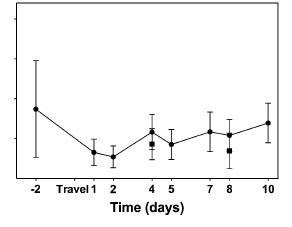
The study looked at five members of the Australian skeleton team before and after a flight to a training camp in Canada that took 24 hours and involved four different flights (so a pretty brutal travel schedule, but not that rare for athletes). Two days before they left, they did a bunch of power tests: box drop jumps, squat jumps, and countermovement jumps. Once they arrived in Canada, they repeated these measurements daily for 11 days. Some Canadian skeleton athletes (who didn’t have to fly) also did some of the tests as a control.

The data, frankly, is pretty messy. Performance clearly drops after the flight, but the various measurements aren’t perfectly consistent about when the biggest drops come and how quickly performance returns. Here’s a bit of sample data, showing the squat jump height. The two squares (instead of circles) are the Canadian controls — they basically just show that there’s not much day-to-day variation in the measurements for non-jetlagged athletes:

So what’s going on? The researchers believe that it’s not just being cooped up in a plane for a day that causes the problems:

We would contend that a symptom of jet lag is circadian misalignment and as such the performance declines that we are reporting are the result of circadian misalignment due to trans-meridian flight.

Seems fairly reasonable. The solution:

This research highlights that where possible, athletes performing explosive short duration efforts as part of a competitive environment should time their arrival in the destination country following long haul travel at least five days prior to the competition.

This I’m a little more skeptical about. Looking at the data, it’s hard to see any particular break point after five days. That being said, in the balance between leaving too little time to recover versus arriving too early and being out of your element for too long, five days does seem like pretty good common sense.

Exercise intensity is more important than duration

THANK YOU FOR VISITING SWEATSCIENCE.COM!

My new Sweat Science columns are being published at www.outsideonline.com/sweatscience. Also check out my new book, THE EXPLORER'S GENE: Why We Seek Big Challenges, New Flavors, and the Blank Spots on the Map, published in March 2025.

- Alex Hutchinson (@sweatscience)

***

This is a really interesting graph:

It comes from a study called the Copenhagen City Heart Study, which followed a random sample of about 12,000 people in Copenhagen for 21 years. This particular data (which was presented at the European Society of Cardiology conference last week) looked at the cycling habits of the subjects, teasing out the separate effects of how hard they typically cycle and how long they spend cycling on a typical day. What you see is that it’s all about intensity: men who typically cycled “fast” (as subjectively determined by self-report) lived 5.3 years longer than those who cycled “slow,” whereas duration had no significant effect.

Since this is just a conference presentation, I don’t have full details on the data and analysis. Obviously there are likely to be some correlations in action — people who are unhealthy for whatever reason are likely to cycle slower and die earlier. That being said, the results were corrected for “age, gender, number of other sports activities, BMI, systolic blood pressure (including antihypertensive medication), HDL-cholesterol, smoking, income, alcohol-intake and diabetes”. Here’s the comparable data for women:

Heart arrhythmias and endurance sports

THANK YOU FOR VISITING SWEATSCIENCE.COM!

My new Sweat Science columns are being published at www.outsideonline.com/sweatscience. Also check out my new book, THE EXPLORER'S GENE: Why We Seek Big Challenges, New Flavors, and the Blank Spots on the Map, published in March 2025.

- Alex Hutchinson (@sweatscience)

***

I’m starting to really dislike these jerks who keep studying Swedish cross-country skiers and producing findings that conflict with my worldview… First it was arthritis; now, the researchers studied 47,000 people who participated in the 90-km Vasaloppet ski race in Sweden between 1989 and 1998, looking for associations between the number of times they participated in the race and the odds that they were subsequently diagnosed with arrhythmias (a task made possible by Sweden’s comprehensive national health records). The result (according to a press release describing a conference presentation; the findings haven’t yet appeared in a peer-reviewed journal):

Compared to those who had completed one single race, those who had completed 7 or more races had 29% higher risk of a subsequent arrhythmia. Further, elite athletes finishing at 100-160% of the winning time had 37% higher risk of arrhythmias than recreational athletes finishing at more than 241% of the winning time.

Leaving aside the quibble that “elite” is a bit generous for someone finishing at 160% of the winning time, the findings seem to suggest pretty clearly that extensive endurance training increases the chances of arrhythmia. The biggest differences were found in subjects under 45, and were exclusively associated with atrial fibrillation and bradyarrhythmias, which are considered less serious than the “potentially lethal” ventricular arrhythmias, according to the researchers:

Dr. Andersen summarizes: “Basically, this study shows, that even though physical activity is generally healthy, athletes committed to endurance sports at elite level have higher risk of suffering from a heart rhythm disorder… We emphasize that we do not find any increased incidence of potential lethal heart rhythm disorders. However, this study only compares athletes at different levels and a future large scale study comparing athletes against the normal population would be very interesting.”

The last point is interesting. It does seem increasingly clear that training as an elite endurance athlete is more likely to have an impact on the heart than training at a recreational level — but what about compared to sedentary life? Is this a linear relationship, or a “U-curve” where moderate training produces the best results?

Bottom line: although the press release skips some relevant details (like how common were these arrhythmias in absolute terms?!), I don’t think this changes my risk-benefit assessment. It’s like the well-known trade-off for exercise of any sort: your chance of a heart attack rises temporarily during extreme exertion, but your overall odds of heart attack decline with exercise. In this case, it’s worth bearing in mind the findings from previous studies of the same race: the more Vasaloppets you do, the longer you live. So whatever the downsides of arrhythmias, they’re evidently outweighed by other benefits.

Obesity, delayed gratification and the Marshmallow Test

THANK YOU FOR VISITING SWEATSCIENCE.COM!

My new Sweat Science columns are being published at www.outsideonline.com/sweatscience. Also check out my new book, THE EXPLORER'S GENE: Why We Seek Big Challenges, New Flavors, and the Blank Spots on the Map, published in March 2025.

- Alex Hutchinson (@sweatscience)

***

A new follow-up to the famous Marshmallow Test study on delayed gratification has just been published. Back in the 1960s, researchers tested a group of pre-school children on how long they could resist the temptation of an immediate reward (e.g. a marshmallow) in favour of a “larger, later” reward (e.g. two marshmallows). They followed these kids for decades, and found that the kids who were able to hold out the longest ended up less vulnerable to outcomes ranging from obesity to divorce to crack cocaine addiction.

The newest update, just published in Proceedings of the National Academy of Sciences (full text freely available here, press release here), with the subjects now in their 40s, confirms that the kids who were “high delayers” are still “high delayers,” and the kids who were “low delayers” are still “low delayers.” For the first time, they used brain scanning to determine that the high delayers showed greater activation in the prefrontal cortex while the low delayers had greater recruitment of the ventral striatum. This may reflect the differing use of of different “cold” and “hot” modes of cognition in choosing between competing impulses.

Anyway, I’m not going to go into great depth about the neuroscience here (as noted above, those who are interested can read the full paper freely). What caught my attention was the following quote in the press release:

“This is the first time we have located the specific brain areas related to delayed gratification. This could have major implications in the treatment of obesity and addictions,” says lead author Dr. B.J. Casey, director of the Sackler Institute for Developmental Psychobiology at Weill Cornell Medical College and the Sackler Professor of Developmental Psychobiology.

One of the interesting debates that I’ve become more attuned to in following the blogs of people like Yoni Freedhoff and Arya Sharma is the tendency to ascribe moral failings — a lack of willpower and unwillingness to make the “right” choices — to obese people. Dr. Sharma frequently argues that “Eat Less, Move More”-type advice is useless for losing weight, because it fails to understand the “countless ways in which the psychoneurobiology, energy physiology and metabolism in anyone who has lost weight” drive you to regain that weight.

So in this picture, does increased power of delayed gratification have any role in treating or avoiding obesity? Or are the biological imperatives too strong for anyone’s self-control? Dr. Sharma had a very interesting post a couple of weeks ago about the role of personal choice in weight loss, responding to a recent paper in the Journal of the American Dietetic Association. He doesn’t reject the role of impulse control in weight loss — in fact, he suggests it should be considered:

Recognising and fully acknowledging how the brain’s neural circuitry that underlies these behaviours interacts with (and is thus ultimately responsive to) environmental situations and cues can perhaps provide a far more realistic and effective counseling strategy.

Of course, losing weight and avoiding weight gain in the first place are two distinct questions — and in the long term, any success we have in tackling society’s growing levels of obesity will probably come from helping future generations avoid obesity in the first place. The Marshmallow Test data does tell us something interesting: that you can predict who’s most likely to become obese based on tests of brain function in pre-school. That has nothing to do with resting metabolic rate, aptitude for sports, or even what they’re being fed at home.

Obviously, this trait isn’t the root of the problem. Presumably humans have always been born with varying degrees of delayed gratification; it’s only in our modern society that low delayers are at risk of obesity. This is consistent with the idea of an “obesogenic environment” — a world with a copious oversupply of calorie-dense food, convenient labour-saving devices always available, ubiquitous advertising to tempt us into taking the first marshmallow.

But still… it suggests that choices matter. I realize this starts to sound like a moral judgement (i.e. obese people must have made the “wrong” choices), but I don’t mean it that way. In fact, the Marshmallow Test tells us these choices are, to some extent, hardwired into us. But by acknowledging the role of choices, and understanding how and why the “wrong” choices are made, perhaps we can increase our odds of making the right choices. Dr. Sharma suggests a few ways this might work in the post I quoted from above. Another option: the idea of “brain training” is in disrepute right now, partly because it was so dramatically overhyped and oversold a few years ago, but maybe it’s something to consider. It’s a topic that comes up (peripherally) in the Jockology column I just wrote for next Monday’s Globe, and I’m looking forward to seeing more research on it.