Massage lowers stress hormones

THANK YOU FOR VISITING SWEATSCIENCE.COM!

My new Sweat Science columns are being published at www.outsideonline.com/sweatscience. Also check out my new book, THE EXPLORER'S GENE: Why We Seek Big Challenges, New Flavors, and the Blank Spots on the Map, published in March 2025.

- Alex Hutchinson (@sweatscience)

***

Massage is a multi-billion dollar industry these days, as a new study in the Journal of Alternative and Complementary Medicine points out. Apparently 8.3% of adults in the U.S. got at least one massage in 2007, “as a treatment for a myriad of conditions ranging from muscle aches, back pain, headaches, and insomnia, to psychologic stress, anxiety, and depression.” But does it actually do anything? It’s a very difficult topic to study, though a few researchers have started to make headway.

The new study, by researchers at Cedars-Sinai Medical Center in Los Angeles, is an interesting one. They gave 53 volunteers either a standard 45-minute Swedish massage (using the “core massage techniques of effleurage, petrissage, kneading, tapotement, and thumb friction”), or 45 minutes of “light touch” therapy using the back of the hand. The hypothesis was that massage would lower stress hormones such as cortisol by increasing levels of oxytocin, the “cuddle hormone” that is involved in bonding, maternal behaviour and a host of other behaviours.

What they found was that cortisol did drop, by 32% in the massage group and 21% in the touch group — so massage was “better.” But oxytocin couldn’t explain the change — it fact, it increased more in the touch group (12%) than the massage group (9%). So the conclusion (in press reports, at least) is that “massage benefits are more than skin deep“; the paper itself concludes that “these findings may have implications for managing inflammatory and autoimmune conditions,” but not through the mechanism they originally expected.

My take: this is not surprising. I would have been astounded if massage didn’t lower cortisol levels. After all, listening to music or getting a nice compliment can lower your cortisol — but we don’t claim that these things can heal muscle pain! What’s most interesting about this study is that the controls received “light touch” therapy, which likely triggers many of the same bonding responses. This gives us the chance to see how much of the effects of massage are due to the pleasurable social/bonding interaction, and how much is due to “effleurage, petrissage, kneading, tapotement” and so on. And the differences aren’t as big as you might hope.

That being said, this study’s outcomes are mostly about general “wellness” rather than sports-related benefits — there’s nothing that tells us what’s happening to muscle fibres and so on. Still, it is (as the authors note) an important first step to separating the general benefits of having someone rub their hands all over you from the specific benefits of certain massage techniques. Hopefully we’ll see more studies like this in the future.
How to taper for a race, and why it works

THANK YOU FOR VISITING SWEATSCIENCE.COM!

My new Sweat Science columns are being published at www.outsideonline.com/sweatscience. Also check out my new book, THE EXPLORER'S GENE: Why We Seek Big Challenges, New Flavors, and the Blank Spots on the Map, published in March 2025.

- Alex Hutchinson (@sweatscience)

***

This week’s Jockology column looks at research into tapering: how to reduce your training before an important competition so that you’re well-rested but don’t lose any fitness. It tackles how long you should taper for (two weeks seems to work well); how you should adjust training volume (reduce by 40 to 60 percent), intensity (don’t change) and frequency (don’t change); and the difference between step, linear and exponential tapers.

The most interesting finding for me came from a new study by Scott Trappe and his colleagues at Ball State’s Human Performance Laboratory, suggesting that tapering isn’t just about rest — it actually helps your muscles grow:

He and his colleagues took a series of muscle biopsies from university cross-country runners preparing for a championship race. Surprisingly, they found that the individual muscle fibres responsible for explosive power in the legs actually got bigger and contracted more powerfully after the training reduction.

“On a molecular level, the wheels are so greased that the engines proceed at a high rate even after you reduce your training,” explains Dr. Trappe. This creates a window of opportunity during which the delicate balance between muscle synthesis and breakdown shifts to favour muscle growth.

In contrast, the researchers found no change in measures of cardiovascular endurance such as VO2max. This suggests that it’s the muscle adaptation that provides the performance boost of tapering – and just as importantly, that a brief period of less training doesn’t compromise endurance. The result: The runners raced 6 per cent faster over 8 kilometres than they had just three weeks earlier. [read the rest of the column]

“Heart rate recovery” and acute vs. chronic training fatigue

THANK YOU FOR VISITING SWEATSCIENCE.COM!

My new Sweat Science columns are being published at www.outsideonline.com/sweatscience. Also check out my new book, THE EXPLORER'S GENE: Why We Seek Big Challenges, New Flavors, and the Blank Spots on the Map, published in March 2025.

- Alex Hutchinson (@sweatscience)

***

I had a chance to see an interesting study in progress a few days ago, during my visit to Cape Town, which prompted me to look up a paper that appeared earlier this year in the European Journal of Applied Physiology. It’s a case study of an elite Dutch cyclist being monitored with something called the Lamberts and Lambert Submaximal Cycle Test (LSCT), which was first described last year in a British Journal of Sports Medicine paper.

The gist is as follows: to warm up before a hard workout, you do a specific 15-minute protocol (6min at 60% of max heart rate, 6min at 80%, and 3min at 90%). You measure your power output and perceived exertion during these three stages, and then you measure how much your heart rate decreases during the 90 seconds after the test. Doing the test frequently (it’s not too strenuous, so you can do it as a warm-up before pretty much every workout) gives you objective data that tells you whether you’re fresh or tired, and whether your training is making you faster or slower.

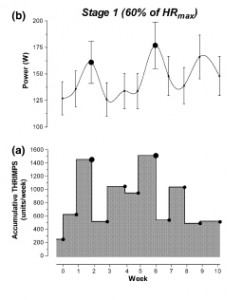
Just as a sample, here’s a snippet of data, showing the power (at a fixed heart rate) for the first stage of the test, compared to the weekly training load. Pretty clear correlation:

lsctYou can see a gradual increase in power as the training cycle progresses, indicating that the cyclist is getting fitter. But you can also see big spikes in power during the heavy training weeks — that’s not because he was “fitter,” but because the acute training-induced fatigue meant he had to work harder (and thus produce more power) in order to get his heart rate up to 60% max. The mechanism has to do with decreased sympathetic nerve activity and increased parasympathetic nerve activity — and what’s most interesting to me is that the exact opposite happens in the case of chronic training-induced fatigue.

The same pattern can be seen in the heart rate recovery data:

lsct2During the heavy training weeks, the athlete’s heart dropped more quickly than during the other weeks. So he was tired from the dramatic increase in training load — but the test suggests that he was what the researchers call “functionally overreached” as opposed to “non-functionally overreached.” Had he persisted with the extreme training load for too long, his heart-rate recovery would have started to dip down instead of up, indicating overtraining. In other words, the researchers conclude:

This suggests that training-induced acute and chronic fatigue are reflected differently in the LSCT, which has important practical applications for monitoring.

Obviously this test is best suited to cycling, since you can precisely measure your power output. But I wonder whether a simplified version of the test, where you just exercise (run, row, whatever) at a set submaximal heart rate and then measure your heart rate recovery, would provide any meaningful information.

Oh yeah, the study I saw in progress: two groups of cyclists, each doing two (I think) hard workouts a week. One group does them on set days, come hell or high water; the other group does the LSCT three times a week, and determines whether or not to work out that day depending on the results. The hypothesis is that working out when your body is ready to go, and resting when it’s not, will lead to greater gains in fitness and performance. It’ll be interesting to see the results.

Kevin Sullivan’s training: seven years of detailed analysis

THANK YOU FOR VISITING SWEATSCIENCE.COM!

My new Sweat Science columns are being published at www.outsideonline.com/sweatscience. Also check out my new book, THE EXPLORER'S GENE: Why We Seek Big Challenges, New Flavors, and the Blank Spots on the Map, published in March 2025.

- Alex Hutchinson (@sweatscience)

***

I don’t know how I missed this, but there was a paper in the December issue of the Journal of Strength and Conditioning Research that is pure track-geek heaven. It’s called “Performance Modeling in an Olympic 1500-m Finalist: A Practical Approach,” and in it, researchers from Eastern Michigan University take seven years of Canadian miler Kevin Sullivan’s logs (from 2000 to 2006) and subject them to detailed analysis.

The goal of the research is to see if they can use basic “impulse-response” training theory to predict upward and downward trends in Sullivan’s race performances. To put it simply, they assume that:

Performance = Fitness – Fatigue

Makes sense so far. Every time time you train, you create some fatigue… and then a little while later, your body compensates by increasing your fitness a bit. So at any given moment, your performance ability can be estimated by adding up the contributions of every training session you’ve done toward your fitness and fatigue. Yesterday’s training session will have a big impact on your fatigue, but none on your performance. A session from three weeks ago, on the other hand, will have a performance impact but not much of a fatigue impact.

So how do you model the impact? Without getting too far into the nitty-gritty, the researchers add up every bit of running Sullivan does and calculate its pace as a fraction of the pace he could maintain all-out for an hour (akin to what runners would think of as threshold pace). A day in which he ran all-out for an hour would get a score of 100. As it turns out, over the course of a full year, he tends to average between 50 and 55 of these “points” per day. During base training, he averages over 60, with individual days sometimes exceeding 100.

So they plug this training data into the “impulse-response” formulas to see if there’s any correlation with performance. Previous studies in other sports have found good predictions averaged over whole teams, but it’s trickier with an individual athlete. They’re not trying to predict exactly how fast he’ll run in a given race — rather, it’s a question of looking for trends, to see whether his “performance score” is getting higher or lower. That way, coaches can react by taking extra rest, training harder, or whatever.

sullivan2

As an example, I’ve included one of the figures here. It shows (A) his 2000 season, when he came fifth at the Olympics, and (B) his 2004 season. The dotted line shows his “training score” — basically how hard he’s training — and the solid line shows his predicted performance. The triangles show his race performances, converted to Mercier points. The circled ones are at the Olympics. In their discussion section, they suggest that maybe he peaked a little too early in 2000 — but it seems to be they’re using their 20-20 hindsight vision to make that call, because that’s not what their model predicts. On the contrary, the solid line is highest right after the Olympics, so maybe he peaked a little late… or maybe he peaked just right. There are many debates that track geeks could have about this data — which is why it’s so much fun!

The original reference: J Strength Cond Res. 2009 Dec; 23(9): 2515-23.

Whole-body compression helps recovery after strength training

THANK YOU FOR VISITING SWEATSCIENCE.COM!

My new Sweat Science columns are being published at www.outsideonline.com/sweatscience. Also check out my new book, THE EXPLORER'S GENE: Why We Seek Big Challenges, New Flavors, and the Blank Spots on the Map, published in March 2025.

- Alex Hutchinson (@sweatscience)

***

Interesting new study on compression garments in this month’s Journal of Strength and Conditioning. A team from the University of Connecticut led by William Kraemer — a big name in the field — had subjects do a heavy eight-exercise weights session, then recover either by wearing an Under Armour Recharge suit for 24 hours or by wearing their usual clothing. It was a randomized, crossover study. (I was very critical of the research Under Armour is using to promote its performance mouthpieces, so I have to give credit here: they funded what I see as a high-quality study.) The punch line:

We observed significant differences between [compression garments] and [controls] in both men and women for vitality, resting fatigue ratings, muscle soreness, ultrasound measure swelling, bench press throw, and [creatine kinase, a marker of muscle damage]. A whole body compression garment worn during the 24-hour recovery period after an intense heavy resistance training workout enhances various psychological, physiological, and a few performance markers of recovery compared with noncompressive control garment conditions.

In other words, it works!

Now, it’s worth noting that they tested a whole laundry-list of parameters, only some of which  showed improvement. The tests of reaction time, sleep quality, countermovement vertical jump and squat jump didn’t show anything. And despite a program that included biceps curl and three other upper body exercises, no changes in upper-body arm soreness were observed. Same for other areas of the body like the thighs.

But overall, it’s a positive message. It’s particularly nice to see changes not just in subjective measures (e.g. How do you feel? How sore are you?) but also in objective measures (e.g. How swollen are your muscles? How far can you throw this?) As I concluded in an earlier post, the evidence is mounting that compression really works — even if we haven’t yet mastered exactly how much is needed where. And of all the proposed uses, recovery after workout-induced muscle damage seems to be the most solid.