Does booze make your sleep better or worse?

THANK YOU FOR VISITING SWEATSCIENCE.COM!

My new Sweat Science columns are being published at www.outsideonline.com/sweatscience. Also check out my new book, THE EXPLORER'S GENE: Why We Seek Big Challenges, New Flavors, and the Blank Spots on the Map, published in March 2025.

- Alex Hutchinson (@sweatscience)

***

Alcohol puts you to sleep — but how good is that sleep? A new study by Japanese researchers (abstract here; press release here) offers some interesting insights. Basically, it helps you get to sleep more quickly, and you sleep deeply for the first few hours, but once the “sedative and hypnotic effect of ethanol” wears off, it messes up the rest of the night and interferes with recovery.

The researchers studied 10 male university students. Each of them did three tests: one with a placebo, one with 0.5 grams of ethanol per kilogram of bodyweight, and one with 1.0 grams. The high dose corresponds to about four standard bottles of 5% beer for someone weighing 70 kg. They drank the beverages 100 minutes before bed, and then their sleep patterns were recorded.

Some background: your body is regulated by a balance between the “parasympathetic” nervous system (responsible for “rest-and-digest” functions) and the “sympathetic” nervous system (responsible for “fight-or-flight” functions). When you’re asleep, the parasympathetic system is supposed to take over and become dominant, helping your body to recover from the rigours of the day. What the Japanese study found for the first time (primarily by measuring heart rate and heart-rate variability) is that alcohol suppresses parasympathetic activity during sleep in a dose-dependent way (i.e. the higher dose of alcohol suppressed parasympathetic activity more strongly than the lower dose). The upshot:

These results suggest that ethanol disturbs the restorative effects of sleep, preventing the heart rate from decreasing and the parasympathetic nerves from becoming dominant. During the last half of the sleep period, when the sedative and hypnotic effect of ethanol wears off, the number of awakenings during sleep and Stage 1 increased under the [high dose] conditions.

Or, from the press release:

“It is generally believed that having a nightcap may aid sleep, especially sleep initiation,” said Nishino. “This may be true for some people who have small amounts of alcohol intake. However, it should be noted that large amounts of alcohol intake interfere with sleep quality and the restorative role of sleep and these negative consequences may be much larger during chronic alcohol intake.”

Bottom line: much like the effects of alcohol on muscle recovery, a few drinks isn’t likely to hurt you (and plenty of evidence suggests that a drink or two a night will improve your health). But more than that can affect your health in subtle ways that you probably don’t even notice.

Cryosaunas enter the realm of real sports science

THANK YOU FOR VISITING SWEATSCIENCE.COM!

My new Sweat Science columns are being published at www.outsideonline.com/sweatscience. Also check out my new book, THE EXPLORER'S GENE: Why We Seek Big Challenges, New Flavors, and the Blank Spots on the Map, published in March 2025.

- Alex Hutchinson (@sweatscience)

***

Okay, I admit I enjoyed making fun of the “cryosauna” last fall, after it emerged that Alberto Salazar had arranged to have one shipped to New York so that Dathan Ritzenhein could use it before the New York Marathon. With the manufacturer promising “tighter, healthier skin,” “increased libido,” and “stronger, fuller hair,” the concept was ripe for a few jokes — especially since there was no actual science supporting its use for athletes.

But now I have to get serious, because a legit study has been published, funded by the French Ministry of Sports (and not by the manufacturer — actually, it’s a German company that made the cryosaunas used in the study). The full text is freely available via this link. The study had 11 trained runners do a pair of 48-minute hilly treadmill runs (i.e. including enough downhill to trigger muscle damage and soreness) separated by at least three weeks. After one of the runs, they were given three minutes of whole-body cryotherapy at -110 C immediately after, and then again once a day for the next four days. After each cryotherapy session, blood tests were taken to measure a bunch of inflammation and muscle damage markers. After the other run, they followed the same protocol, except replacing the daily bout of cryotherapy with 30 minutes of passive sitting.

One thing to emphasize: this study appears to have been very carefully executed. Throughout the study, the subjects were told exactly how much they were allowed to run, and they weren’t permitted to use anti-inflammatories or other recovery aids. They also controlled food and drink intakes.

The results? They’re pretty complicated because they tested a lot of things. For most of the markers, there was no difference. But there were three key differences:

  • C-reactive protein, a marker of muscle damage, stayed almost unchanged in the cryotherapy group, whereas it spiked after 24 hours in the control and was still elevated three days later.
  • Interleukin-1beta, a pro-inflammatory cytokine produced after strenuous exercise, was slightly suppressed by cryotherapy (though not by much, if you look at the data below).
  • Interleukin-1ra, an anti-inflammatory cytokine inhibitor that counteracts the pro-inflammatory cytokines, was temporarily but significantly enhanced immediately after the post-exercise cryotherapy session.

Here’s what the data for those three factors looked like (WBC is whole-body cryotherapy; PAS is passive recovery):

So does this settle any debate? Well, there’s always a big gap between seeing a minor change in some blood test and translating that to a functional benefit for an athlete. Does cryotherapy permit a better next-day or day-after-tomorrow workout? We don’t really know. On a more general level, do the benefits of (hypothetically) more rapid recovery outweigh the (hypothetical) disadvantages of suppressing the inflammatory signals that tell your body to adapt and get stronger? Again, we don’t really know — that’s still in the realm of coaching art, not science. Is a massively expensive cryosauna any better than a bathtub with a few blocks of ice thrown in? Still don’t know.

But having said all that, this study does suggest that we can move the cryosauna from the category of “wacky techno-schemes that sound like you mail-order them from the back of a comic book” to “serious recovery modalities that are as likely as anything else we currently rely on to work.” (Though I’m still reserving my judgement on the “better hair” claims.)

Platelet-rich plasma for tennis elbow

THANK YOU FOR VISITING SWEATSCIENCE.COM!

My new Sweat Science columns are being published at www.outsideonline.com/sweatscience. Also check out my new book, THE EXPLORER'S GENE: Why We Seek Big Challenges, New Flavors, and the Blank Spots on the Map, published in March 2025.

- Alex Hutchinson (@sweatscience)

***

Platelet-rich plasma therapy was a super-hot topic a couple of years ago (see earlier blog posts about it), in part because of reports that top athletes like Tiger Woods were using it to speed their recovery from injuries. These days, the fuss has died down a bit. The novelty is gone, subsequent studies haven’t produced the “miracle” results promised by initial case reports, and maybe no one wants to emulate Tiger Woods anymore.

Anyway, studies of PRP continue to trickle in, but the picture isn’t necessarily getting much clearer. Two new studies have just been posted online at the American Journal of Sports Medicine, one of which is a randomized trial of PRP for tennis elbow by researchers in Greece. The design seems pretty good in theory: 28 patients were split into two groups; one group received an injection of PRP (their own blood, spun to produce plasma with elevated levels of healing-enhancing platelets), while the other group received an identical injection of their own unenriched blood. This should eliminate the problem of placebo effects (which are very big in invasive procedures that involve lots of needles), and test only whether the platelets themselves make any difference.

But there’s a problem:

This is a single-blind study. Patients were aware of the treatment because it was practically difficult to mask the process.

I don’t understand this. Maybe there’s something I’m missing — if you know why it would be “practically difficult” to mask the process, please let me know. It seems to me that all you have to do is put the blood-spinning machine in the room next door, and you’re in business with a double-blind study. But that’s not what they did — and to me, that’s an enormous problem, given how much publicity PRP has received over the past few years.

Anyway, the results: they measured subjective pain and perceived elbow function at various points over the next six months. There was only one case where the two groups showed statistically significant differences: pain was lower in the PRP group after six weeks, though the difference was no longer significant at the next measurement (3 months). On the other hand, if you ignore “statistical significance,” the trend was that the PRP patients did better in every measurement.

So how do you interpret these results? It’s pretty clear that the authors of the paper are big boosters of the technique:

[T]here is enough proof to support the superiority of PRP treatment over autologous blood, regarding pain, in the short term…

More studies on this topic could further enlighten aspects of this promising treatment…

In conclusion, we showed that PRP led to pain relief earlier than autologous whole blood, and we believe its application will be increasingly widened in the near future…

Really, I don’t think they showed any such thing. They found results that were statistically insignificant in five of their six outcomes, using two measurements that are largely subjective, in an experimental design that does nothing to eliminate placebo effect for one of the most heavily hyped sports medicine treatments of the past decade. To justify the cost and extra effort required for PRP therapy, they’re going to need more definitive results than that.

Ice baths for recovery: 15 minutes at 10 C

THANK YOU FOR VISITING SWEATSCIENCE.COM!

My new Sweat Science columns are being published at www.outsideonline.com/sweatscience. Also check out my new book, THE EXPLORER'S GENE: Why We Seek Big Challenges, New Flavors, and the Blank Spots on the Map, published in March 2025.

- Alex Hutchinson (@sweatscience)

***

Post-workout ice baths are one of those things that everyone believes in, no matter what the science says. There have been a bunch of ice bath studies, but they’ve used lots of different water temperatures, immersion times, and outcome measures, and the results have been very mixed. This month’s European Journal of Applied Physiology has a study from France’s National Institute of Sport that looks like the strongest evidence yet in favour of ice baths — and offering some concrete advice on water temperature and immersion time.

One key difference from previous studies: they used elite athletes — 41 football, rugby and volleyball players — whose recovery might be expected to be faster than untrained volunteers. They tested four different protocols:

  • TWI: body-temperature water (36 C) for 15 minutes;
  • CWI: cold water (10 C) for 15 minutes;
  • CWT: contrast water (10 C and 42 C), alternating 90-second bouts for 15 minutes;
  • PAS: no water — just sitting there for 15 minutes.

The exercise they used to induce fatigue and muscle damage was alternating bouts of hard rowing and counter-movement jumps. They took blood samples and tested muscle strength (MVC), jump height, and power produced during 30 seconds of rowing — and they did those tests before and immediately after the exercise, then again one hour and 24 hours later.

As you can imagine, with all those different test groups and protocols, the results are a bit of a jumble. The key result, as far as I’m concerned, is right here:

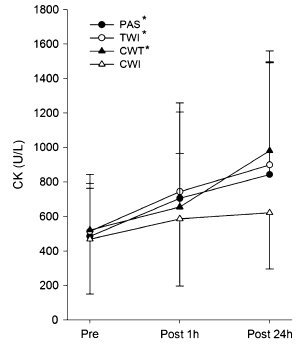
This is the data for creatine kinase, which is a commonly measured marker related to muscle damage. Its exact significance is often debated, but the authors of this study suggest it’s a sign of “reduced passive leakage from disrupted skeletal muscle, which may result in the increase in force production during ensuing bouts of exercise.” The key: the ice bath outperforms all the other interventions, including the contrast bath.
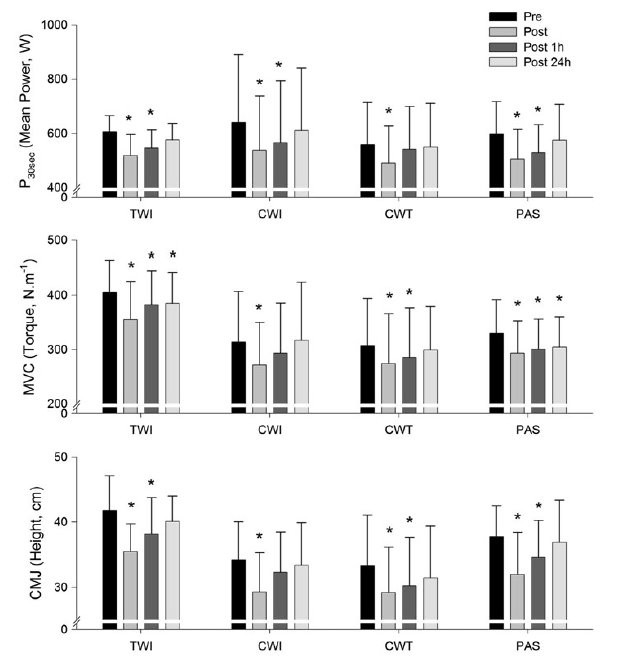
Of course, nothing is quite that simple. If we look at the performance measures, the picture gets muddier:

What we’re interested in here is the cases where performance returns to “normal” quickly. The asterisks indicate where performance is reduced from the first bout by a statistically significant amount. The broad conclusion we can draw is that both the ice bath and the contrast bath seem to offer some advantages compared to room temperature water or not bath. The main reason I included this data is to show that it’s not a simple, magical effect. It’s complicated. But for practical purposes, this data gives me more confidence than any previous study to support the very strong anecdotal evidence that a sustained cold-water bath — in this case, 15 minutes at 10 C — helps to speed up recovery after hard workouts.

Training one limb reduces soreness in the other limb

THANK YOU FOR VISITING SWEATSCIENCE.COM!

My new Sweat Science columns are being published at www.outsideonline.com/sweatscience. Also check out my new book, THE EXPLORER'S GENE: Why We Seek Big Challenges, New Flavors, and the Blank Spots on the Map, published in March 2025.

- Alex Hutchinson (@sweatscience)

***

This one surprised me. It’s a new study from the University of Exeter, just published online in the European Journal of Applied Physiology, about DOMS (delayed onset muscle soreness), the exact causes of which have been hotly debated for years (including a section in Cardio or Weights, I might add).

Here’s what they did: 15 volunteers did a hard biceps workout with one arm, emphasizing eccentric rather than concentric contractions in order to produce more post-workout soreness. Two weeks later, they did the same workout; half of them (okay, 7) did the workout with the same arm as before, while the other half did the workout with the opposite arm. An hour after each workout, and then again 24 and 48 hours later, the researchers measured a series of parameters related to soreness, including loss of strength, perceived soreness, and resting arm angle.

As expected, due to what’s known as the “repeated bout effect,” the amount of post-workout soreness was less after the second workout than after the first workout. What’s weird is that it was less even when the subjects did the workout with the opposite arm!

Apparently, this effect has been observed in one previous study, though the results weren’t quite as clear. And it fits with other results showing that training your right arm (for example) can lead to strength gains in your left arm. In that case, it’s not that the muscles in your left arm get bigger — instead, it’s neural adaptations. As your brain learns to send “contract!” signals more effectively to your right arm, it does so symmetrically, so some of the benefits transfer to your left arm. Something similar appears to happening with the post-workout soreness:

Data from the present study, therefore, provide limited evidence that the neural adaptations that provide protection from EIMD [exercise-induced muscle damage]  following a second bout of exercise are likely to be centrally [i.e. in the brain] mediated.

A clue as to how this might work comes from the EMG data they took of muscle activity during the workouts. Eccentric muscle contractions preferentially recruit fast-twitch muscle fibres, which thus sustain greater damage than slow-twitch fibres. As a result, during the second of two exercise bouts you automatically use a higher proportion of slow-twitch fibres — and that shows up as a change in the average frequency of muscle activity measured by EMG, which decreases by 20-30% because there are more slow twitch contributions. In the new experiment, this is exactly what the researchers found: the muscle frequency decreased in the second bout, no matter which arm they used. The brain seems to have learned from bitter experience that it should recruit fewer fast-twitch fibres, and it applies that lesson to both arms.

So what’s the practical value of this? If you have an injury that immobilizes one arm or leg, this suggests that training the opposite limb, with a focus on eccentric contractions, can help protect the bad limb from muscle damage once you start rehabilitation exercises. And hey, it’s also just a pretty cool piece of trivia.