Yoga’s dose-response effect

THANK YOU FOR VISITING SWEATSCIENCE.COM!

My new Sweat Science columns are being published at www.outsideonline.com/sweatscience. Also check out my new book, THE EXPLORER'S GENE: Why We Seek Big Challenges, New Flavors, and the Blank Spots on the Map, published in March 2025.

- Alex Hutchinson (@sweatscience)

***

This week’s Jockology column in the Globe and Mail takes a closer look at a neat yoga study that I blogged about last month. I got in touch with Nina Moliver, the researcher responsible for the study, and looked at the data more closely:

When Nina Moliver decided to study the long-term health and wellness effects of yoga for her doctoral research in psychology, one of her professors offered some advice.

“The yoga world doesn’t need more testimonials,” the professor at Arizona’s Northcentral University told her. “The only way you’re going to communicate with the medical community is with numbers.”

Yoga science is a burgeoning discipline, with researchers probing yoga’s effects on everything from stress hormones to skin conditions. But how can a typical four- to six-week study capture the benefits of an ancient mind-body discipline that takes years, if not decades, to master? It can’t, Dr. Moliver concluded – so she decided to take a radically different approach that offers the first quantitative look at yoga’s long-term benefits. And the results of her study are promising for dedicated yoginis…. [READ ON]

One little online extra that I’ll post here is one of the graphs from the study, to give a sense of what the data looks like. Basically, you get data points filling the triangle on the upper left of the graph, while the lower right remains empty.

Here’s how I describe the data in the Globe article:

Interestingly, the most experienced yoginis weren’t necessarily happier or healthier than the happiest and healthiest non-yoginis, at least in the parameters Dr. Moliver was able to measure. “They didn’t find ‘enlightenment’ that others can’t reach,” she says. The biggest differences were at the other end of the scale, in the scarcity of unhealthy or unhappy long-time yoga practitioners.


When Nina Moliver decided to study the long-term health and wellness effects of yoga for her doctoral research in psychology, one of her professors offered some advice.

“The yoga world doesn’t need more testimonials,” the professor at Arizona’s Northcentral University told her. “The only way you’re going to communicate with the medical community is with numbers.”
More evidence that heat is in your head (or neck)

THANK YOU FOR VISITING SWEATSCIENCE.COM!

My new Sweat Science columns are being published at www.outsideonline.com/sweatscience. Also check out my new book, THE EXPLORER'S GENE: Why We Seek Big Challenges, New Flavors, and the Blank Spots on the Map, published in March 2025.

- Alex Hutchinson (@sweatscience)

***

In the last month, I’ve posted about palm cooling, face-warming, and a study that suggested that some of the slowdown we experience in hot weather is attributable to the brain rather than body overheating. The latest addition to this theme: a study on neck cooling, published online in Medicine & Science in Sports & Exercise a few days ago.

The gist: Seven cyclists performed a 15-minute time trial in 30 C heat, after riding for 75 minutes to heat themselves up. They did it once as a control, once while wearing a “cooling collar” (essentially an icepack that fits around their neck while riding), and once with the cooling collar being replaced every 30 minutes to keep it colder. As expected, the cooling collar improved performance in the time trial by about 7% (this has been demonstrated before); but replacing the cooling collar didn’t produce any further gains, even though any cooling effect had disappeared long before the time trial started.

What’s most interesting is that there were no differences between groups in any of the physiological variables they measured — rectal temperature, hormones like seratonin and dopamine, lactate levels, etc. The differences appeared to be purely perceptual:

It has been proposed that during self-paced exercise the intensity is regulated by a complex network of feedback and feed-forward systems regarding the physiological state of the body to allow for the completion of the task within homeostatic limits. The data from the current study and from a previous investigation using the same protocol suggest that cooling the neck enhances preloaded time-trial performance in a hot environment by masking the extent of the thermal strain…

Or, to put it simply, it’s in your head. That doesn’t mean that heat doesn’t have real physiological effects — just that, in most cases, our brains take the heat into account to slow us down prematurely.

strain9The critical core temperature and central governor theories are the two main theories proposed to
explain the impairment in sporting performance observed in hot temperatures and both models propose that there are
mechanisms in place to prevent the onset of a dangerously high internal temperature

How effective are placebos for headaches?

THANK YOU FOR VISITING SWEATSCIENCE.COM!

My new Sweat Science columns are being published at www.outsideonline.com/sweatscience. Also check out my new book, THE EXPLORER'S GENE: Why We Seek Big Challenges, New Flavors, and the Blank Spots on the Map, published in March 2025.

- Alex Hutchinson (@sweatscience)

***

We all know that placebos work (even if we know we’re taking a placebo, as this study showed). But how well do they work? Researchers in the Netherlands did a meta-analysis of 119 headache studies to evaluate the recovery rate among the placebo/control groups. The verdict: 38.5% of patients given placebo pills recovered, while 15.0% of patients in control groups that didn’t receive pills recovered.

This isn’t surprising, of course (though it’s nice to see some numbers to get a sense of scale). But what does it mean? How do we use this information? A recent McGill study found that one in five Canadian doctors acknowledged prescribing placebos to their patients. The German Medical Association, meanwhile, just released a report from its scientific advisory board encouraging greater use of placebos:

“The placebo effect plays a critical role in every day practice,” says Robert Jütte, lead author of the report. Indeed, a survey of German doctors found that half of them had used a placebo before. In the southern German state of Bavaria, the figure was close to 90%. Jütte says that this majority is right: “Every good doctor should have a couple of white or blue sugar pills handy.”

To me, the ideal scenario is that we devote more research resources to understanding how and why placebos work — though of course there’s little incentive (and strong disincentives, in some ways) for pharmaceutical companies to pursue this topic. Is deception really necessary for this effect to work? Or is it possible that, once we understand it better, we’ll be able to harness the power of the brain in a more controlled (and honest) way.?

Launching today: Cardio or Weights!

THANK YOU FOR VISITING SWEATSCIENCE.COM!

My new Sweat Science columns are being published at www.outsideonline.com/sweatscience. Also check out my new book, THE EXPLORER'S GENE: Why We Seek Big Challenges, New Flavors, and the Blank Spots on the Map, published in March 2025.

- Alex Hutchinson (@sweatscience)

***

Today’s the day that my new book, Which Comes First, Cardio or Weights? Fitness Myths, Training Truths, and Other Surprising Discoveries from the Science of Exercise, finally hits stores. It’s my attempt to bring together what we know (not what we think!) about how the body responds to various types of exercise, training, nutrition and recovery protocols, divided in 12 chapters and 111 Q&As. You can read the full Table of Contents here, and there are links to the many places you can order from here.

The initial reactions have been encouraging. Amby Burfoot at Runner’s World gave it a really nice review (and did a brief author Q&A with me); Kirkus Reviews called it “factual, information and empowering.” There will — hopefully — be plenty more reviews and interviews over the next few weeks. [UPDATE: Here’s a review from Jimson Lee at SpeedEndurance, and a Q&A with Jonathan Goodman of the Personal Trainer Development Center.]

There are also a few upcoming events I’d like to highlight:

  • I’ll be at the Ottawa Marathon fitness expo from Thursday, May 26 to Saturday, May 28, answering questions and signing copies of the book in the Canadian Running magazine booth.
  • On Friday, June 3, at 7 p.m., I’ll be giving a free talk on the Science of Running at Boutique Endurance in Montreal.
  • On Monday, June 6, I’ll be giving a free talk on the Science of Marathon Training at the Scotiabank Toronto Waterfront Marathon Launch Night at the Downtown Marriott in Toronto. This one’s also free, but you need to RSVP at this page. [UPDATE: this one’s now sold out.]

Thanks to everyone who has read and supported the blog over the years!

Is strength training really better than cardio for weight loss?

THANK YOU FOR VISITING SWEATSCIENCE.COM!

My new Sweat Science columns are being published at www.outsideonline.com/sweatscience. Also check out my new book, THE EXPLORER'S GENE: Why We Seek Big Challenges, New Flavors, and the Blank Spots on the Map, published in March 2025.

- Alex Hutchinson (@sweatscience)

***

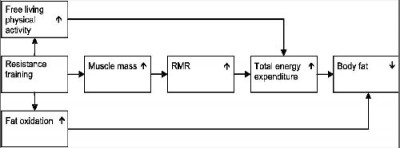
I did a radio interview today with Angela Kokott on QR77 in Calgary, and one of the questions we discussed was the perennial claim that lifting weights is better than aerobic exercise for burning calories. It’s a claim that isn’t totally crazy — even the most recent American College of Sports Medicine position stand on weight loss reverses earlier stands by acknowledging the possibility that resistance training could contribute to weight loss by elevating resting metabolic rate, increasing fat oxidation, and making people more active generally. Here’s the funky flowchart they use to illustrate this process:

Still, the “evidence statement” endorsed by the position stand is: “Resistance training will not promote clinically significant weight loss.” In other words, it’s a nice theory, but the studies of actual people losing weight don’t back it up.

The reason I bring this up is that James Fell has a good article in the Los Angeles Times that tackles this topic — in particular, taking on the oft-repeated whopper that every pound of muscle burns an extra 50 calories a day. He turns to Claude Bouchard of Pennington Biomedical Research Center, who offers the following breakdown of resting metabolic rate (RMR):

Brain function makes up close to 20% of RMR. Next is the heart, which is beating all the time and accounts for another 15-20%. The liver, which also functions at rest, contributes another 15-20%. Then you have the kidneys and lungs and other tissues, so what remains is muscle, contributing only 20-25% of total resting metabolism.

The punchline, according to Bouchard: a pound of muscle burns about six calories a day while a pound of fat burns two calories a day. Don’t get me wrong: strength training is great for many reasons, and I certainly encourage everyone (including, reluctantly, myself) to do some. But it’s not a miracle weight-loss technique.