Breathing patterns and stride rates

THANK YOU FOR VISITING SWEATSCIENCE.COM!

My new Sweat Science columns are being published at www.outsideonline.com/sweatscience. Also check out my new book, THE EXPLORER'S GENE: Why We Seek Big Challenges, New Flavors, and the Blank Spots on the Map, published in March 2025.

- Alex Hutchinson (@sweatscience)

***

Do you ever find that your breathing locks into sync with your stride when you’re out running? Or with your pedal cadence when you’re cycling? (No points if it happens when you’re swimming.) It happens to most people, but it comes and goes, so there’s been decades of debate about whether it’s a “good” thing, and whether we should try to synchronize breathing with stride. I go into this topic (plug alert) in my new book (pp. 83-85, for the record), but I just noticed a new study in the European Journal of Applied Physiology which adds some interesting insight. It’s a little bit involved, but it’s pretty interesting — so bear with me!

First things first: this was a study (by researchers at UMass-Amherst) of walking, not running — but it’s likely that the same basic processes are at work. Essentially, there are two cyclic systems at work: the “locomotory” system (your legs) and the respiratory system (your lungs). Both are fulfilling separate goals (to keep you moving as efficiently as possible, and to keep your muscles supplied with oxygen), but they also interact with each other — e.g. changing stride can drive greater demand for oxygen. So you’ve got what physicists call a “coupled oscillators” system. The question is: when the two systems are in sync, do they function more efficiently? Do you burn less oxygen at a given pace if your breathing matches your pace?

Here’s what the study did: it had volunteers walk at a natural pace at whatever stride frequency felt natural. Then, keeping the same pace, it had them increase or decrease stride frequency by 10% and 20%, while doing sophisticated monitoring of how closely the breathing rate matched the stride rate, and also monitoring oxygen consumption (a measure of efficiency).

First finding: forcing stride frequency away from its preferred “natural” value made the walkers less efficient. They consumed more oxygen when they either increased or decreased their stride. This is exactly as expected, and has been observed in many previous experiments.

Second finding: changing stride frequency had no effect on how often breathing rates locked in with stride rates — it stayed pretty much the same. Since efficiency changed and synchronization didn’t, this suggests that synchronization doesn’t help (or hurt) your efficiency. Previous studies have found conflicting results for this question, so this is an interesting observation.

But here’s the key finding. The number of different synchronization patterns was greatest at the naturally chosen stride rate. At the lower and higher frequencies, subjects were more likely to lock into their favourite pattern, which was two strides per breath. At the preferred stride frequency — where they were most efficient — they spent a greater proportion of time jumping to different patterns, like 3:1, 4:1, 2.5:1, 4.5:1 and even 7:1. Here’s the data:

So what does this mean?

This would indicate that the greatest variation in the dominant coupling strategy used allowed the participant to explore coupling strategies with the goal of minimizing oxygen consumption.

In other words, we’re efficient at our “natural” stride frequency not because we can breathe in sync with our strides, but (in part) because we don’t let ourselves get locked into one breathing pattern. Instead, we’re unconsciously trying different breathing patterns constantly, finding the one that’s most efficient at that moment and then re-optimizing a  moment later. The moral: don’t try to consciously lock your breathing into a prescribed pattern.

(This doesn’t mean you should never pay any attention to your breathing. It may be, for example, that in stressful race situations you have a habit of breathing shallowly because of nerves. Trying to look out for this and correct it is different from, say, trying to exhale on every second left footstrike.)
Muscular endurance linked to running economy

THANK YOU FOR VISITING SWEATSCIENCE.COM!

My new Sweat Science columns are being published at www.outsideonline.com/sweatscience. Also check out my new book, THE EXPLORER'S GENE: Why We Seek Big Challenges, New Flavors, and the Blank Spots on the Map, published in March 2025.

- Alex Hutchinson (@sweatscience)

***

I blogged a few weeks ago about a study on strength training and cycling efficiency, and a commenter asked why so many of these studies are done on cyclists rather than runners. In response… here’s a interesting running study, just posted online at the Journal of Strength and Conditioning Research, that looks at muscular endurance and running economy.

The question they set out to ask was: does having better muscular endurance allow you to maintain better running economy (i.e. burn less energy while running at a given pace) as you get tired? To test it, they asked 10 well-trained runners to do two 30-minute runs at a moderate pace. In the middle of one of the runs, the runners had to speed up to VO2max pace for four minutes, then slow back down — enough to tire them out a bit without exhausting them. As expected, their running economy got worse after the four-minute surge by 3.0%. This is typical: as runners get tired, their running economy gets worse.

What remains hotly debated is why, exactly, running economy gets worse with fatigue. I’m not going to delve into the details of all the various mechanisms that have been proposed to explain this — it’s almost certainly caused by a mix of many different factors. One possibility relates to your knee flexors (a.k.a. hamstrings and surrounding muscles on the back of your leg above the knee) [UPDATED 6/27: had mistakenly written knee extensors], which contract eccentrically to act as a “brake” during each stride. There’s some evidence that eccentric contractions decline more quickly than concentric contractions during exercise — so as that braking action gets less effective as you fatigue, your stride gets less efficient.

Okay, now we finally get to the point. The researchers also tested the eccentric muscle endurance of the knee and hip flexors and extensors of all their subjects, then looked for correlations with the running economy results. Sure enough, they found that eccentric knee flexor endurance was “strongly related” to how much running economy worsened after the fast section of the run. Bingo!

So what does it mean? Well, there’s a big chasm between saying “hamstring quad endurance and running economy changes are linked” and concluding “therefore, you should do X, Y and Z in training.” However, it’s not crazy to see this as a good argument for some lower-body strength training and plyometrics. Here’s what the authors conclude:

Our results suggest that coaches and athletes could effectively implement conditioning strategies that challenge eccentric muscle actions. These strategies include plyometrics, resistance training with an emphasis on eccentric portion of repetitions, down-hill running and over-speed training.


Can you “acclimatize” to cold temperatures?

THANK YOU FOR VISITING SWEATSCIENCE.COM!

My new Sweat Science columns are being published at www.outsideonline.com/sweatscience. Also check out my new book, THE EXPLORER'S GENE: Why We Seek Big Challenges, New Flavors, and the Blank Spots on the Map, published in March 2025.

- Alex Hutchinson (@sweatscience)

***

I’ve been blogging a bunch about heat (it is summer, after all), so I figured for balance I should mention this new study in the European Journal of Applied Physiology about acclimatization to cold, since it’s not a topic we hear about much. Researchers at Kent State compared five “cold-weather athletes” with eight controls matched for fitness, physical activity, size, etc.,  in a graded cycling test to exhaustion at 5 C. The result: the cold-weather athletes were more efficient than the controls:

Specifically, [cold-weather athletes] had ~20–30% lower VO2 at submaximal workloads, compared to [non-cold-weather athletes].

Cool, huh. So what’s going on here? Well, they don’t really know. When we talk about heat, we know there are specific physiological changes that occur with acclimatization, like increased sweat rate and blood flow to the skin. The researchers suggest that it’s “possible” that cold-weather athletes were “more able to buffer lactate at a given workload due to their experience with exercising in cold ambients,” though it’s not clear to me why that would be.

Another point worth mentioning is that the cold-weather athletes were actually football players, and their cold-weather exposure consisted of about 10 hours a week of winter practices in temperatures hovering around freezing. Morever, they were special teams players (punters, kickers, long snappers), “so it follows that they did not acquire as much activity as other athletes on the football team (i.e., only 20–30 min per practice were spent doing kicking drills and the rest of the time involved mainly standing or sitting in the cold).”

Oh. So these were not speed skaters or something. So I’m not convinced that there was any serious cold acclimatization. And as far as I can tell, the study didn’t have a control trial to make sure that the football players weren’t just more efficient (from better training) than the controls under all conditions. (They did a familiarization trial at room temperature, but didn’t analyze the results). All in all, I think the only thing we can conclude from this study is that “cold acclimatization” is an interesting concept that doesn’t get enough attention and merits further study.

Static stretching lowers cycling effiency and time-to-exhaustion

THANK YOU FOR VISITING SWEATSCIENCE.COM!

My new Sweat Science columns are being published at www.outsideonline.com/sweatscience. Also check out my new book, THE EXPLORER'S GENE: Why We Seek Big Challenges, New Flavors, and the Blank Spots on the Map, published in March 2025.

- Alex Hutchinson (@sweatscience)

***

What we know so far: static stretching seems to cause a decline in maximal power, strength and speed, as well as hurting running economy in endurance runners. What a new study in the Scandinavian Journal of Medicine & Science in Sports reveals: stretching is bad for cyclists too — possibly even worse than it is for runners.

The authors of the study, from the University of Milan, argue that the performance-damping effects of stretching may be more obvious in endurance cycling than in running. The reason is that type II muscle fibres (a.k.a. fast twitch) are affected more than type I muscle fibres (slow twitch) by stretching. When you’re running at below-threshold paces, your leg muscles are only applying about 20% of their maximal force, so they can rely mainly on type I fibres. Cycling, on the other hand, requires a greater proportion of maximal force: about 60% of max force at 85% VO2max, according to the paper. As a result, cyclists recruit a higher proportion of type II fibres, and are thus more vulnerable to stretching-induced weakness.

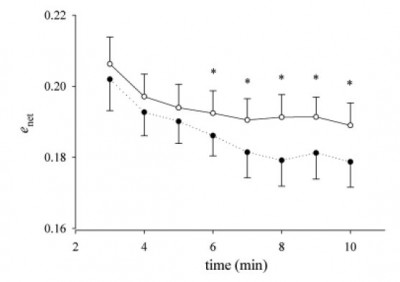
That’s all fine in theory — but what do the experiments say? The researchers did a series of tests of VO2max, mechanical efficiency, time to exhaustion (with the power set at 85% of power at VO2max, so that exhaustion took about 30 minutes), and so on. Here are the efficiency results, with open circles corresponding to no stretching and closed circles corresponding to 30-minute pre-exercise stretching routine:

On average, efficiency was about 4% lower after stretching. The time to exhaustion was decreased by 26% after stretching (22:57 vs. 31:12).

I’ve been explaining the reduction in running economy caused by stretching by talking about the legs as a set of springs that store energy (and do so less efficiently when they’ve been stretched). But these results suggest that the effects of stretching on the muscle fibres themselves (and perhaps on neuromuscular signalling pathways) are just as important, since cycling doesn’t rely on that springy-legs effect.

Anyway, this is, as always, just one study — but probably worth keeping in mind if you do a lot of static stretching before cycling.

Extreme exercise: Tour de France cyclists live longer

THANK YOU FOR VISITING SWEATSCIENCE.COM!

My new Sweat Science columns are being published at www.outsideonline.com/sweatscience. Also check out my new book, THE EXPLORER'S GENE: Why We Seek Big Challenges, New Flavors, and the Blank Spots on the Map, published in March 2025.

- Alex Hutchinson (@sweatscience)

***

A little bit of exercise is good for you, but too much is bad for you. That seems to be a fairly widespread societal view — certainly anyone who trains seriously as a runner or cyclist or other endurance athlete is familiar with all the comments about how training so much can’t be good for you. And to be fair, there has been some recent research that raises questions about whether running multiple marathons over an extended period of time can damage your heart.

So I was very interested to see a study, forwarded by Brian Taylor (thanks!), that just appeared in the International Journal of Sports Medicine. Spanish researchers decided to study the records of cyclists who rode the Tour de France between 1930 and 1964 — an example of “extreme” exercise if ever there was one — and see how long they lived compared to the general population. They focused on riders from France, Italy and Belgium (who comprised 834 of the 1229 riders for whom birth records were available), and they compared the longevity of those riders to the general population from their home country in the year of their birth. Here are the aggregate results in graphical form:

The trend is pretty clear. The age by which 50% of the population died was 73.5 for the general cohort, and 81.5 for the Tour de France riders — who, according to the paper, ride about 30,000 to 35,000 km per year (though I’d be surprised in the riders competing in the 1930s were training as hard as modern riders).

So what does this tell us? Well, as in any case-control study, there are plenty of limitations on the conclusions we can draw. First of all, this doesn’t prove that “extreme” exercise is better than “moderate” exercise. It may be that riding 30,000 km/year is significantly better than doing no exercise at all (or than doing the relative pittance that the average modern person does), but is still worse for you than riding, say, 10,000 km/year. But it’s pretty clear that extreme levels of aerobic training don’t shorten your life. As the authors put it:

In our opinion, physicians, health professionals and general population should not hold the impression that strenuous exercise and/or high-level aerobic competitive sports have deleterious effects, are bad for one’s health, and shorten life.

It’s also worth mentioning some potential confounding factors. The paper notes that former athletes tend to smoke less, drink less alcohol and have a healthier diet than the general population. Fair enough: these factors almost certainly contribute to the increased longevity of the riders. Again, the conclusion we can draw isn’t that extreme riding makes you healthier; it’s that it doesn’t make you less healthy.

What about genetics and selection bias? Maybe the Tour de France riders tend to be the type of lucky person with a great metabolism who’s destined to be healthy for his entire life no matter what he does, and it’s those great genetics that predisposed him to become a competitive cyclist. Again, not an unreasonable point. In response, the authors point out a 2010 British Journal of Sports Medicine paper in which researchers in Sweden compared the genetic profiles of 100 world-class male endurance athletes (“Olympic finalists or Europe/World Champions and Tour de France finishers”) with 100 matched controls. They looked at 33 “risk-related mutations and polymorphisms” associated with cardiovascular disease, hypertension, insulin resistance, cancer, and other major causes of mortality — and found no difference:

[T]he overall picture suggests that there is no evidence that elite male world-class endurance athletes are genetically predisposed to have a lower disease risk than non-athletic controls. Thus, the previously documented association between strenuous aerobic exercise undertaken by elite athletes and increased life expectancy is likely not biased by genetic selection.

Bottom line: if the question is “How much exercise is too much?”, I still think the answer is “Way, way more than you think.”