THANK YOU FOR VISITING SWEATSCIENCE.COM!
My new Sweat Science columns are being published at www.outsideonline.com/sweatscience. Also check out my new book, THE EXPLORER'S GENE: Why We Seek Big Challenges, New Flavors, and the Blank Spots on the Map, published in March 2025.
- Alex Hutchinson (@sweatscience)
***
Here’s a bit of a loaded question: does your pacing strategy — even? positive splits? negative splits? — reveal something about your cognitive development? I blogged a few weeks ago about the perennial question of 1,500-metre tactics and whether going out a fast pace is smart or stupid, so I was interested (and amused) to see a new study from Dominic Micklewright at the University of Essex, just posted online in Medicine & Science in Sports & Exercise, called “Pacing Strategy in Schoolchildren Differs With Age and Cognitive Development.”
It’s actually a really neat and thought-provoking study. Here’s the gist: the researchers studied four groups of children (aged 5-6, 8-9, 11-12, and 14). Each group was asked to run a time trial over a distance that took them about four minutes to finish — so similar to the demands of a 1,500-metre race in adults, actually. Here’s what the pacing for each group looked like:

The basic conclusion from this data:
Younger schoolchildren with less advanced cognitive development exhibited a negative pacing strategy indicating an inability to anticipate exercise demand. Older schoolchildren at a more advanced stage of cognitive development exhibited a more conservative U-shaped pacing strategy characterised by faster running speeds during the first 15% and last 20% of the run.
In other words, young kids go out very fast and fade from the front, while older kids understand the pain that awaits them and hold some energy back until they’re sure they’ll make it to the finish. But there’s more to it than that. The researchers also administered tests to determine where the kids fit into Piaget’s four stages of cognitive development — and they saw roughly the same pattern: kids with a lower stage of cognitive development went out hard and got progressively slower, while the kids with more advanced cognitive development had the U-shaped curve — which, I should point, is exactly the pacing strategy adopted by world-record-setters at distances from 1,500 to 10,000 metres ever since the IAAF started keeping records.
I should clarify (before Rob Watson kicks my ass) that the link between pacing between cognitive development and pacing is mostly related to age. Once you’re a grown-up (and in particular, once you’re racing against other people rather than just against the clock), there are many different reasons to adopt different pacing strategies. Let me repeat: I’m not saying that going hard means you’re dumb!
What this research is really about is “anticipatory regulation of effort” — which is basically just a rebranding of what’s sometimes called the central governor theory. (Debate about the central governor has become so personal that many scientists seem unable to actually read new studies about it, instead criticizing the ideas that were proposed 10 years ago.) Here’s how the authors of the new study put the idea into evolutionary context:
The survival of certain animals is contingent upon the successful deployment of energy conservation strategies such as the regulation of feeding, physical exertion and rest. Such energy conservation strategies are imperative to successfully completing predetermined survival activities within biological and environmental constraints. Humans use similar energy regulation strategies to successfully conduct their daily living activities albeit with less emphasis than other animals on survival. This is particularly apparent in the way humans pace themselves during athletic activity to avoid premature fatigue.
What’s fascinating is that this anticipatory pacing strategy appears to be hardwired into us. By the time we reach the third Piaget stage, we’re already pacing ourselves in exactly the same (much-debated) way that the runners who set distance-running world records do: a fast start, a slower middle, then a fast finish.
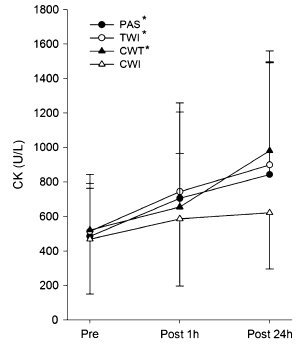 This is the data for creatine kinase, which is a commonly measured marker related to muscle damage. Its exact significance is often debated, but the authors of this study suggest it’s a sign of “reduced passive leakage from disrupted skeletal muscle, which may result in the increase in force production during ensuing bouts of exercise.” The key: the ice bath outperforms all the other interventions, including the contrast bath.