Power Balance bracelets in placebo-controlled experiment

THANK YOU FOR VISITING SWEATSCIENCE.COM!

My new Sweat Science columns are being published at www.outsideonline.com/sweatscience. Also check out my new book, THE EXPLORER'S GENE: Why We Seek Big Challenges, New Flavors, and the Blank Spots on the Map, published in March 2025.

- Alex Hutchinson (@sweatscience)

***

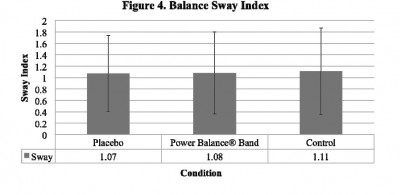
I’m embarrassed to even report on this study — but just in case there are still any Power Balance believers out there, researchers at the University of Texas at Tyler have just published a placebo-controlled, double-blind, counterbalanced test of strength, flexibility and balance, in the Journal of Strength & Conditioning Research. They compared Power Balance bracelets to the same bracelets with the “energy flow distributing Mylar hologram” removed, and to nothing at all. And, believe it or not, they found no differences. For example:

And for all those who still swear that, when the salesman put the bracelet on their wrist, they really did do better on the balance test, it’s worth noting the University of Wisconsin pilot study (cited in the Texas paper) that found that in balance and flexibility tests like the ones used by Power Balance salespeople, you always do better the second time you try it, due to learning effects. So if you try the test first with the bracelet on, then with the bracelet off, you’ll “prove” that the energy flow actually harms your balance. (Or maybe that just means you had the bracelet on backwards…)

The activitystat hypothesis: do we have an exercise set point?

THANK YOU FOR VISITING SWEATSCIENCE.COM!

My new Sweat Science columns are being published at www.outsideonline.com/sweatscience. Also check out my new book, THE EXPLORER'S GENE: Why We Seek Big Challenges, New Flavors, and the Blank Spots on the Map, published in March 2025.

- Alex Hutchinson (@sweatscience)

***

If you do a vigorous workout in the morning, will you be correspondingly less active for the rest of the day, so that your total physical activity ends up being the same as if you hadn’t worked out at all? That’s the basic gist of the “activitystat” hypothesis, which Gretchen Reynolds described in a New York Times article last week (thanks to Ed for the heads-up!). It’s also the topic of a pro vs. con [EDIT: had the links backward before -AH] debate in the current issue of the International Journal of Obesity (full text free available).

Reynolds describes several interesting studies that line up in favour of or against the theory, including one (from the same issue of IJO) that compared three British elementary schools with very different amounts of in-school physical activity. Here’s what that study found:

You can see that, for both “total physical activity” and “moderate and vigorous physical activity,” one group had much higher levels in school than the other two, but compensated by doing less outside school. On the surface, it seems like a pretty compelling argument in favour of the activitystat hypothesis.

My take: somewhere in the middle, as usual. It would be ludicrous to claim that the body doesn’t regulate physical activity based on previous exertions to some degree. Do a one-day study of “voluntary movement” among people who have run a marathon that morning, and of course you’re going to find that they chill out more. At the opposite extreme, it would be equally silly to argue that all people everywhere in the world do exactly the same amount of physical activity. Or that any given person’s physical activity stays essentially constant over long periods of time  — again, think of someone who goes from sedentary to marathon training: no amount of fidgeting or taking the stairs will add up to the exertions of 100-mile weeks. (For more examples of the role of environment in determining activity level, read the “con” commentary I linked to above. E.g. Nandi children in Kenya who grow up in the countryside are more active overall than Nandi city kids — an obvious result, but one that clashes with the activitystat idea.)

So the relevant question isn’t “Do compensatory mechanisms exist?” It’s “Do they matter, and are they insurmountable?” As lovely as the data from the British school study is, I don’t find it convincing. The school with the highest in-school physical activity was a fancy boarding school in the countryside, while the other two schools were urban. If the boarding-school kids play an hour of cricket in phys ed every day, the fact that they don’t choose to go play an hour after school doesn’t necessarily mean that the activitystat is limiting them. Maybe they just want to (or have to, depending on the other extracurricular requirements of the school) do something else.

One final point: it would be interesting to stratify those results based on the activity levels of the kids. Does the apparent activitystat mechanism apply equally to the most active and least active kids? Because if there are some kids who, left to their own devices, only get a total of 50 minutes of moderate/vigorous activity per week, then giving them 100 minutes a week in school is going to benefit them — and there’s nothing any activitystat can do to stop it!

Higher carb intake = faster Ironman finish

THANK YOU FOR VISITING SWEATSCIENCE.COM!

My new Sweat Science columns are being published at www.outsideonline.com/sweatscience. Also check out my new book, THE EXPLORER'S GENE: Why We Seek Big Challenges, New Flavors, and the Blank Spots on the Map, published in March 2025.

- Alex Hutchinson (@sweatscience)

***

Here’s a graph, from a recent paper on nutrition during long (marathon and longer) endurance competitions, that’s worth a close look:
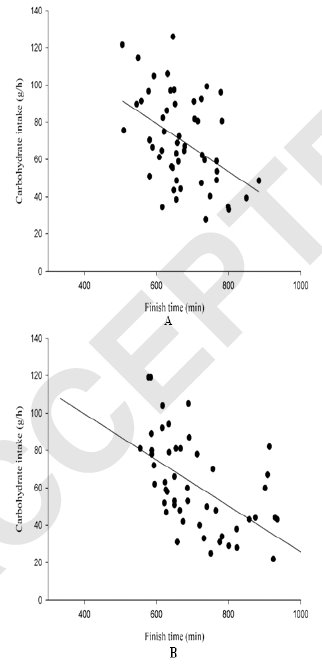
What do you see? A bunch of dots scattered randomly? Look a bit more closely. The data shows total carb intake (in grams per hour) by racers in Ironman Hawaii (top) and Ironman Germany (bottom), plotted against finishing time. It comes from a Medicine & Science in Sports & Exercise paper by Asker Jeukendrup’s group (with several collaborators, including Canadian Sport Centre physiologist Trent Stellingwerff) that looked at “in the field” nutritional intake and gastrointestinal problems in marathons, Ironman and half-Ironman triathlons, and long cycling races. The basic conclusion:

High CHO [carbohydrate] intake during exercise was related to increased scores for nausea and flatulence, but also to better performance during IM races.

So basically, taking lots of carbs may upset your stomach, but helps you perform better. It’s important to remember that gastrointestinal tolerance is trainable, so it’s worth putting up with some discomfort to gradually raise the threshold of what you’re able to tolerate.

Anyway, back to that graph: while it may look pretty random, statistical analysis shows a crystal-clear link between higher carb intake rates and faster race times, albeit with significant individual variation. Obviously there are some important caveats — it may be, for example, that faster athletes tend to be more knowledgeable about the benefits of carbs, and thus take more. Still, it’s real world data that tells us the people at the front of the race tend to have a higher carb intake rate.

One other point worth noting. The traditional thinking was that humans generally couldn’t process more than 60 grams of carb per hour. Over the last few years, thanks to multiple-carb blends, that threshold has been pushed up to 90 grams of carb per hour. In this data set, about 50% of the triathletes were taking 90 g/hr or more.

[UPDATE 10/26: Given all the comments below about the variability in the data, I think it’s worth emphasizing what should be a fairly obvious point. The only way this data would come out as a nice straight line is if Ironman finishing time depended ONLY on carb intake, and was totally independent of training, experience, talent, gender, body size, and innumerable other factors. This is obviously not the case, so we should expect the data to be very broadly scattered. What the statistical analysis shows is that, with p<0.001, faster finishers tended to have consumed carbs at a higher rate. There are many ways to interpret this data; one possibility is that, if your carb consumption is below average, you might wish to try a higher rate of consumption (e.g. 90 g/hr) to see if it helps.]

Can you trust your own judgment about health/fitness?

THANK YOU FOR VISITING SWEATSCIENCE.COM!

My new Sweat Science columns are being published at www.outsideonline.com/sweatscience. Also check out my new book, THE EXPLORER'S GENE: Why We Seek Big Challenges, New Flavors, and the Blank Spots on the Map, published in March 2025.

- Alex Hutchinson (@sweatscience)

***

Just wanted to highlight a book excerpt that ran in the New York Times Magazine over the weekend, from Nobel Prize-winning psychologist Daniel Kahneman’s forthcoming book “Thinking, Fast and Slow.” It’s about our general tendency to place great faith in our own explanations for things, regardless of whether the facts bear them out:

The confidence we experience as we make a judgment is not a reasoned evaluation of the probability that it is right. Confidence is a feeling, one determined mostly by the coherence of the story and by the ease with which it comes to mind, even when the evidence for the story is sparse and unreliable. The bias toward coherence favors overconfidence. An individual who expresses high confidence probably has a good story, which may or may not be true.

[…] When a compelling impression of a particular event clashes with general knowledge, the impression commonly prevails.

The main example he discusses in the excerpt is the world of finance — many, many people (including just about everyone I know, seemingly) are convinced that they or their financial advisors are capable of outperforming the market, despite ample evidence that this is nearly impossible to do on a consistent basis. But the good stock picks they’ve made over the years make such a vivid impression that they remain convinced of their abilities.

The reason I’m blogging about this here is that I think this phenomenon is also nearly universal when it comes to health and fitness. Of course, there are many people who either don’t believe in or don’t understand the scientific method. They trust their instincts in figuring out which potions and pills are helping them in vague and unquantifiable ways. This is not surprising at all. What is surprising to me is the number of people who understand and profess belief in the scientific method, who murmur all the right catchphrases about “correlation is not causation” and “of course n=1 anecdotes don’t mean anything,” and yet are still absolutely convinced of their ability to determine which stretch has enhanced their power or saved them from injury, or which pill makes them feel more energetic, or which type of training has enhanced their lactate clearance.

There is some good news at the end of Kahneman’s excerpt: it is possible to have real intuitive expertise. (“You are probably an expert in guessing your spouse’s mood from one word on the telephone,” he notes. Chess players and medical diagnosticians are other example.) But there’s a necessary condition:

Is the environment in which the judgment is made sufficiently regular to enable predictions from the available evidence? The answer is yes for diagnosticians, no for stock pickers.

Maybe I’m just a particularly complicated human, or unusually incapable of reading my body’s signals. But given the huge number of factors, both intrinsic and extrinsic, that affect the day-to-day variation in my mood, energy and physical performance, I don’t consider my own body “sufficiently regular” to be able to make accurate judgements about the efficacy of any particular single intervention.

Aging: does the average decline as much as the extremes?

THANK YOU FOR VISITING SWEATSCIENCE.COM!

My new Sweat Science columns are being published at www.outsideonline.com/sweatscience. Also check out my new book, THE EXPLORER'S GENE: Why We Seek Big Challenges, New Flavors, and the Blank Spots on the Map, published in March 2025.

- Alex Hutchinson (@sweatscience)

***

My Jockology column in today’s Globe and Mail takes another look at aging and physical decline:

It’s the chicken-and-egg question of aging: Do we become less active as we get older because our bodies start to break down, or do our bodies start to break down because we allow ourselves to become less active?

For years, it was widely accepted that humans would start getting slower, weaker and more fragile starting in their 30s. But new studies on topics ranging from the cellular mechanisms of aging to the time-defying performances of masters athletes are forcing researchers to question this orthodoxy. It seems increasingly likely that the first signs of decline are more a function of lifestyle than DNA: If you keep using it, you’ll be well into middle age before you start losing it. [READ THE WHOLE ARTICLE…]

One of the studies discussed in the article is this analysis of the finishing times of 900,000 German marathoners and half-marathoners, published last year. The researchers argue that the rate of decline of mid-packers is a better way of judging “natural” aging processes compared to the outliers who set age-group world records. For fun, I plotted the average finishing times of the runners in the German study, and superimposed the curve that you’d get if they declined at the same rate as age-group records. It’s pretty clear that this group of midpackers does decline at a slower rate: